Tuesday, April 27, 2010

The Craziest Adventure I've Ever Had!

April 18, 2010


We started out early this morning from the farm and headed south to Ginir but only went about 3 or 4 kilometers before we had to turn back because of the bad road conditions. So went back to the farm and then decided that we could take an alternative route that went North up to Beltu and then southwest to Sheik Husein and then back down to Ginir over to Robe Shashamene and then upto Addis. We knew there was a more direct route from Sheik Husein to Addis which would cut off about 4-5 hours but we heard that it was perilous and there would be no place to get help if we needed it. We decided that when we got to Sheik Husein we would ask the local people about it, and if they said it was passable, then we would take that route in order to shorten our trip and make it to Addis is one day. The driver did not want to take the direct route, but we settled between us Americans that we would make it happen if we could. So we set out once again from the farm. I saw hut after hut, camel after camel, donkey after donkey, and one little dirty urchin after another, everything that I’m used to after living here for a month. We made the ride in a filthy van that had a driver and his assistant who looked like he was about 14. The assistant’s job was to hang out the window periodically and look to see how the tires were holding up. I felt sorry for him and as the day went along, I gave him cookies, chocolate, watermelon gum, and pepsi. The driver stole my orange soda pop and so I was mad and gave his assistant treats and him nothing. The driver would only go about 30 kilometers/hour and so we knew it was going to be a long arduous journey.

 Beehives in a tree.
There are very few paved roads here in Ethiopia. The road we traveled was a dirt road sometimes graded, but usually not. It reminded me of roads out on the desert in Emery County or the reclamation road that crosses over to Wyoming only worse.
         We bounced along for about two hours when we came to a truck at the side of the road. To our surprise it was one of our loader drivers on his way back to the farm from Ginir with a loader tire. The truck he was traveling in had a flat tire and so they had stayed on the side of the road over night. He told us that during the night, two lions had come and walked around the area and scared him. He did not want to stay overnight there again and wanted us to turn around and take him to Beltu. We said no because we had to make it to Addis tonight to catch flights to America. So we left him there with the lions nearby and we went on to Sheik Hussein. This town is a pilgrimage town for the Muslims here in Ethiopia. I believe it is important because 100s of years ago this Sheik Husein man was instrumental in converting many of the southern tribes of people to Islam. So they honored him by building an all white mosque in his little town where he lived.


Many people during the months of May and September make the journey to Sheik Husein and I don’t know what they do there once they get there. Probably they face Mecca and pray. After driving there, I don’t know why anyone would want to make the trip. It is absolutely NOT worth the torture. I got some pics of the mosque, and it was interesting in a very muslim Ethiopian kind of way. The town itself was made of rocks. Really, the houses, fences, roads were all rocks, and I know why; because I have never seen a rockier place in my life. I thought Utah was rocky, but it is not close to Sheik Husein and the surrounding area. The area was dry and arid with lots of cactus like plants covering the terrain.


We talked to the people in Sheik Husein and asked them if the route north to Addis Ababa was a good route and if there were bridges across the rivers at the bottom of the canyons. We were assured that it was a very good route, but it would be very steep and scary for the driver who was already getting to be a pain because of his tortoise like pace. We picked up a man there who said he would guide us, if we would take him to another village on the way. At this point Bracken took over driving and we headed out of Sheik Husein. I don’t have the desire to go back to that flea bitten town.

We soon came to the first of the deep canyons that we had to travel.  Our little road wound down the sides of the canyons farther and father. I took some pictures, but I know they won’t do it justice. It was probably 45 minutes down to the bottom where there was a large dirty river churning through some farmland and immense green canopy-like trees covering the banks. It wasn’t like a rain forest, but it was very green considering what we had left up on top. We soon came to the first of the bridges and then we were climbing up the canyon back to the top. The views were spectacular and the road was narrow, rocky, and without any guardrails. If you lost your brakes going down you would be toast. However, there were copious amounts of huge boulders in the road, that had obviously fallen from the cliffs overhead into the road that could be used to stop a truck from plummeting over the side of the cliff, but a smashed grill and radiator would be the very least of the damage.


So we went up and down two more times adding on three more hours and finally came out on top into a very dry area with many people herding cattle on the road. I had to ask myself, where in the heck are these people going? It just didn’t look like they could be headed anywhere except off into the rocks and dirt. And they did not look too friendly. I realized, because they were a little different looking that these were Somali people. They wore different clothes, have a different language and were not used at all to a vehicle traveling through their dusty land. They really stared at us. I enjoyed looking out the window and trying to get some good pictures of the endless trail of women and children driving the cattle along the sides of the road.


 After a while we came to a place with a little more fertile ground and we saw some small fields and some gardens next to the huts. I saw squash plants, yams, something that looked like radishes and some corn. And all of the people have to haul water from the local watering hole. There is no such thing as a well out there. I saw watering holes by the side of the road and women and children dunking there containers in the murky dirty water to haul it home again. I believe that these women have to spend most of their time hauling water and firewood to sustain their families. Then we came to an area where they were building a lot of cell towers. Ethiopia has contracted with some Chinese company to build cell towers all over the country. Not very many of them work. There is even a phone tower being built in Beltu, but it isn’t finished either. The land started looking a little greener and more fertile as we traveled northwest.


 Alan talking on the phone to Marty.  Good grief, when he gets a signal he has to talk.
 This is Nadi or Natnael Haile.  He is hired as a financial bookkeeping type of employee.  He also is teaching the kids science and math.  He is a computer science major and his story is really cool.  I love this boy.  Such a wonderful person.  He laughs at us because we can't pronounce certain words lik "tibs" correctly, but we laugh at hime because he can't say "thistle." 

The driver's assistant saw that one of the tires was getting low so we had to stop and change it here in a very beautiful spot.  So picturesque. 
This was what I was looking at as the tire was being changed.  I said it was picturesque!  Beautiful land, beautiful colors, beautiful people, beautiful little wood-carrying donkeys.  Soooooo cool.


We stopped in a very raucous looking town, because the assistant had spied one of the tires was getting low. We found a tire changing business and Nadi and the driver ran to get some lunch. There was no way I was going to get any good food in that town, but we did buy some very dry hard bread, and a box of nasty Ethiopian cookies to munch on. This town, out of all the towns I’ve traveled through here in this country absolutely shocked me. So many chat chewers, naughty boys, and filthy children; more than usual. Bracken said it was much nicer than Ginir. If that is the case, I never want to go to Ginir.

 Looking up the main road of the town
 Looking in the opposite direction. 

Looking down a side road off the main road.         

Bracken can always entertain the locals.  Here he is with a crowd of rowdy boys in a chat-chewing town.
As we were departing I saw a naked man walking down the road. I yelled, “Hey, hey, hey, there’s a naked man over there! I need to get a picture!” But Alan laughed and just kept driving. He explained that he had seen some too while here and that it is OK. There are some tribes here that do not wear clothing, and so they just go naked. Everyone understands that it is OK and they don’t get worked up about it. Only white forenjee women get worked up about a naked man strolling through town frequenting the local businesses. I just really thought it would have been cool if I had got a picture of him.

Next we came into an area that had lots of fields of coffee beans, chat, and corn. It was a very busy area and almost every field was being worked by women weeding and men plowing with oxen and a wooden plow. I got some pictures of all this agricultural display. It was pretty cool. Alan kept saying that we needed to cross some mountains that were to our left in order to get up to Addis. Remember, there are no road signs or maps of this area out here. For that fact, there are no road signs in Addis Ababa which is the capital. You just have to know they way to get there. We stopped when we came to a T in the road which led off to the left. We stopped and asked the locals and they said we should take that road to get to Addis and I thought they said about 56 kilometers to the paved road. Hello! They must have said 256 kilometers and I just didn’t pick up on the first part. At the T in the road, Alan took his turn driving and I swear we drove and drove and drove with me thinking we were going to get on the paved road any minute. This was the most interesting part of the drive, but because I was a nervous wreck from thinking we had taken the wrong road, I couldn’t enjoy it. I was convinced that Alan and Bracken were taking us off into western Ethiopia and I kept asking, “Are you sure you know where you’re going?” Alan and Bracken weren’t worried at all and just kept talking and laughing and bumping along in our crazy van.
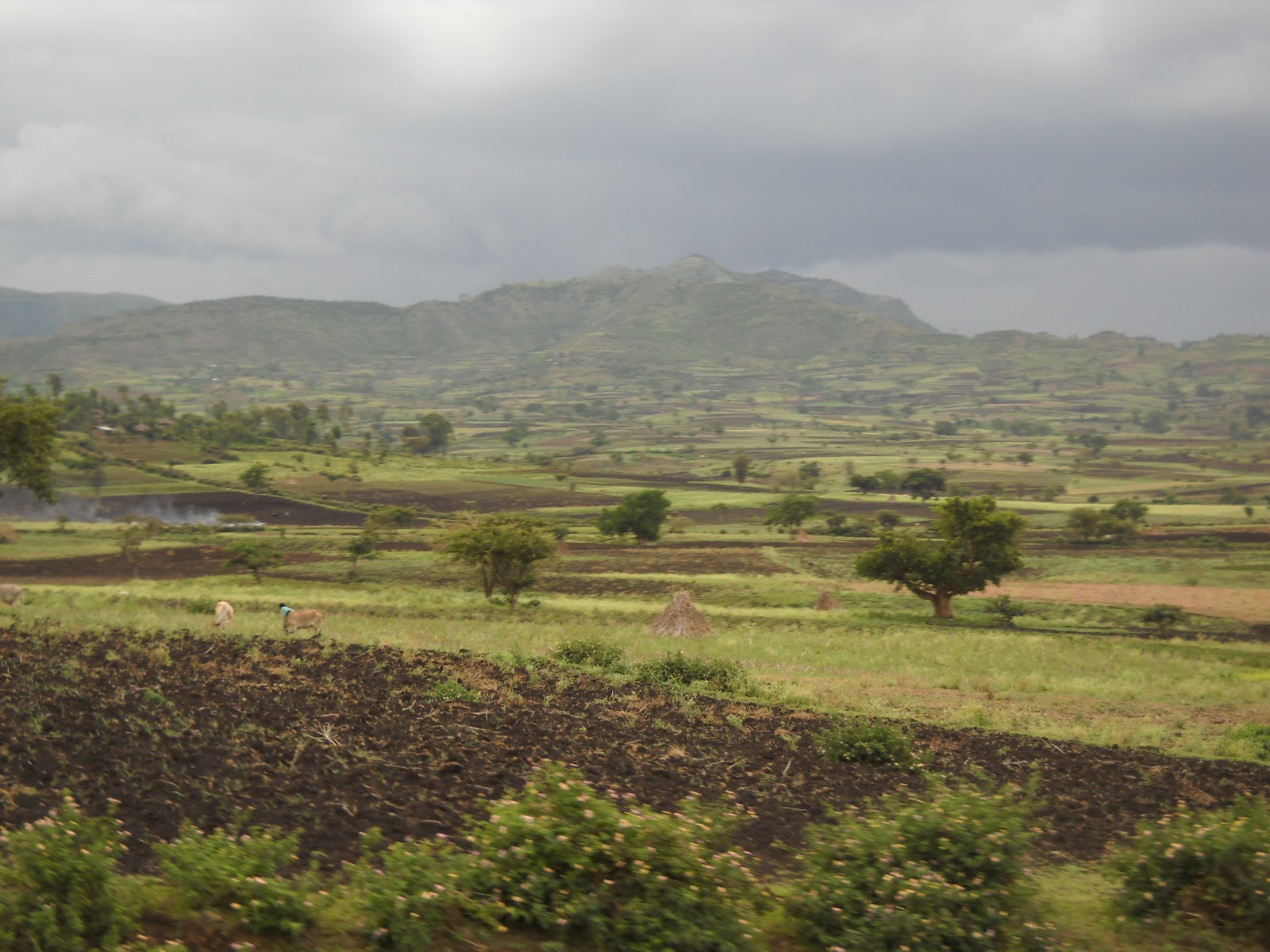


Every once in awhile, Bracken or Nadi would look back at me and ask if I was alright and I just kept praying that we were not headed off into some no man’s land. The area was amazing because we were in some beautiful highlands which were green and wet looking. Even as we would climb up and around the mountains we would look down and there would be clouds below us and off to the side. Half naked children would run down to the road to shout at us as we went by, jumping up and down and waving their hands, screaming and laughing. You know how in the states there are dogs that chase cars down the roads; here the cars get chased by naked dirty children. It’s funny to see little children without pants running toward you because their little bare bottoms are just out there for all to see. I think they go without pants because they’re easier to potty train. It was the longest part of the ride for me. We saw men farming on the sides of mountains growing their meager amounts of coffee and whatever else. The people looked like they were just worn out, but they did have a beautiful view. I wonder if it comforts them to know that they can wake up every morning and see that amazing view from their dung caked hut. Somehow I doubt it.


This is the best map I could make work to show you our route.  We started at the farm 90 kilometers just north east of Ginir which is in the bottom right hand corner of this map.  We headed north east toward Shek Husen on the dotted line. Then we followed the red line mostly north and came out at the place near Awash, then headed south west toward Nazeret, then northwest toward Debre Zeit and Addis.  I know it doesn't look very far, but it took us a good 14 -16 hours.  
It started getting dark as we were winding our way down out of the highlands, and we could see off in the distance some lights of a community, which is an extraordinary sight here in Ethiopia.into a city called Mechara or something like that. And then we came to Awash which was where we finally got onto the paved road that comes from the northeast area of Somalia and Djbouti. The roads are not nearly as good as you would expect them to be because they are rutted and crowded with large trucks coming and going to the ports. There are no highway weight limits here, hence you get badly rutted roads from the heavy overloaded trucks driving in the heat. Alan says that the road is possibly worse in the daylight, because people are walking on the sides of the road with animals, carts, children, etc., and you have to slow down to a crawl.

The driver wanted to drive at this point but he was terrible. He would not go faster than about 30 kilometers/ hour and he would almost pull off the side of the road when a truck passed us going the opposite direction. . Our driver decided to announce at this time that he would not drive us to Addis. He told us that he could not drive in the dark, because his van was not insured to drive after 6:00 p.m. or darkness. Holy cow! We had been driving a couple of hours in the dark. He said he would only drive as far as Nazaret, which is about 150 kilometers from Addis. Nadi had to translate all of this to us and I could tell he felt bad telling us what our crazy driver said. We had a while to get to Nazaret still, and so Alan said, “Stop this van now! We’re not going any farther until we get some things straight.” Alan was really ticked and he told him that we weren’t going to go any farther in his van unless Bracken drove. He told him that he was a terrible driver and that we didn’t trust him to get us to Nazaret. The driver was ticked off and told us that he and his van would not go past Nazaret because it was broken. So Bracken drove, while Alan made arrangements to get us from Nazret to Addis. Alan called Marty from the office and told him our predicament; Marty recommended that we call Joe for help, and Joe recommended Ashabur to us to get some help. Ashabur to the rescue! (BTW Ashabur is the branch president of a one of the branches here in Ethiopia) Ashabur arranged with a friend of his to meet us in Nazaret with a van and then to convey us to Addis. By the time we met Ashabur and his friend in Nazret, we were exhausted from our trip. In Nazret we left our van driver, his assistant, and Nadi. Nadi is from Nazret and was going to see his mom and dad whome he hadn’t seen for over a year. He was very happy and so were they. His mom jumped in the van and kissed us all because she was so happy to see Nadi.
     It was about 9:30 and we still had to get to Addis. The ride was uneventful because I couldn’t see anything because of darkness. I just want to say now at this time that I really dislike Ethiopian music. When I was in Argentina, I developed a dislike for Argentinian music. It’s just a thing that happens to me. As we were traveling, the new van driver turned up the volume on his radio and Alan, Bracken and I endured blaring, beating music that eventually gave me a terrific headache. And now I dislike Ethiopian music. We dropped Ashabur off in Debra Ziet and continued on to Addis and got here about 10:30 – 11:00 p.m. We were so relieved to have made it safely. It is the most adventurous ride I’ve ever undertaken. Half the time I didn’t know what was happening, so if we were in danger or peril, I didn’t know about it. I just tried to sit back and take it all in. We were taken to one of the guest houses – very nice – and I had a hot shower, Bracken made ramen noodles, and Alan just sat back looking stunned and exhausted. We had run the gamut of terrain and emotions and lived to tell about it.

April 11 - April 17, 2010 and Saying Goodbye

Sunday April 11, 2010


Today Alyssa’s children came by van from Shashamene. They have been traveling since Friday, I believe. Also with them, came Thicary, a nurse from the Village of Hope. He has come to assess our needs and do a little first aid training with us. He will be very surprised by all of the patients we have lined up for him.

 Thicary our nurse for two weeks

 A little girl who had a badly burned leg, a little boy with a swollen abdomen and limbs, a baby who had ulcers all over her body, and a little baby who had a scabby encrusted head and was balding from it.


Alyssas’ children are Mesafint, Mumbarek, Dambitu, Tofik and Gutama. I’m sure they were excited to be here. They seem very nice and I hope they will enjoy getting to know the farm and the people here. Thursday is Mesafint’s birthday, and he’s turning 15!

We had church today. Clair gave a talk and I led the gospel discussion and was helped by Mufasint, who seemed to have an answer for everything. We discussed the children of Israel leaving Egypt, the parting of the red sea, etc. Everyone was tired and we surely need to get a better rest on Sunday. There is too much working on the Sabbath day.


Monday April 12, 2010 and My Second Meltdown, a Parade, and a Motorbike Ride

Today is sweet Lily’s first birthday. Happy Birthday sweetie, we love and miss you so much. Today they finally fixed the stove in this house so it would work. I had been waiting for over two weeks. It was so nice to be able to cook something – anything. Our food choices are not wide or deep. We have to eat a lot of starchy foods; potatoes, rice, pasta, bread, etc. And meat is not plentiful. There is very little in the way of fresh produce. I got so ticked off on Monday morning when I still had no stove, that I had to start threatening. To cool off, I went for a walk north toward the village of Goro RaaYaa. It’s about three miles away, and I was determined to get there and look at the school. As I was walking up the road, I started collecting some company. First, just two children, a boy and a girl, started following me. I heard them talking and laughing now and then. As I continued walking, I could tell more and more people were following me. I would look back to see how many I had gathered and I had about ten and then a little farther on I probably had 20. I knew they were all curious about why the white "forenji" came to walk up their road. I wondered if they were too afraid to walk by me so I stopped to admire some cactus and a corn field hoping that they would all continue walking, but no. They all came to a stop with me and watched me look at the cactus and corn. I turned around and smiled at them and continued walking. Finally after about one mileI couldn’t stand it anymore, and I turned around and faced them and said, “Are you following me?” There was surprise on all their faces and the two children ran off into the cactus. I asked them again if they were following me, and still no reply. Then one of them got courageous and asked, “How old are you?” I said, “Fifty two, How old are you?” “What ees your name?” asked the same man. I said, “Shelley, What ees your name?” Suddenly I got several responses. It seems like they know this one phrase. So, I talked to them a little about how beautiful the cactus was and how the man who farmed the corn should be congratulated for raising such a nice crop of corn - they had no idea what I was talking about. They were so interested in looking at me, they could have cared less what was coming out of my mouth. So I carried on a little more small talk as they watched and then I just turned around and walked back the way I had come. They were very surprised that I turned and walked the other way and just stood there watching me leave. I hope they soon get used to the few Americans that are here, and I don’t have to have a parade when I walk up to Goro RaaYaa. When I came back to the farm, two farm guards came hurrying up to me and motioned that I should not be out on the road. They wanted me to go back to the house, but I tried to tell them I wasn’t finished walking and I was going to walk some more. I could tell they wanted me to go to the house, but I kept saying no. Suddenly a little phrase that Ashreka taught me came to my mind. I blurted out, “ Walkie dema jira,” and I pointed very determinedly down the road to the south. Then the guards smiled and motioned for me to go walking. Lucky I knew how to say, “I am going walking” in Oromifa. When I finally did finish my walk, which was not for another two hours, Alan and Haile joined me and we got rained on. They had come upon me as they were driving from the fields and they got out and walked home with me leaving Bracken to drive the pickup land cruiser home.

This afternoon as the stove was getting hooked up, Alan wanted to check GPS hectare information and had to ride one of the motorbikes out to the east fields where they have been clearing and plowing, and I went with him. It’s probably about three miles out. On the way we saw camels, cows, turtles, goats, filthy children and a village I had never seen. Children came running out and then there came women running out. Alan said, “Oh, that looks like one of your patients, and sure enough, one woman was carrying a little girl with a bandaged knee.

I immediately recognized the woman running toward us and told Alan to stop. She wanted us to look at the little girl who had just been down to the farm earlier that day having her leg doctored by Thicary. Soon we were surrounded by women and children who wanted to look at us and talk. Too bad Alan is such a bad conversationalist. I, on the other hand, can talk to the village women about anything. And they also don’t understand anything I say, but I can still talk a lot. We smiled and talked and then we waved good-bye and drove on. We soon came upon some of our workers (about 8 of them), far out in a field changing a tractor tire. The men in charge were the mechanics, Wubishet and a man whom Clair calls Elvis, I don’t know why.


   Wubishet is the one in Clair's coveralls.  Clair gave them to him and he thinks he's all that now. 
Elvis speaks pretty good English and has offered Clair one of his daughters for a wife if he will take her to America. The tire got changed and then they had to push the tractor to get it started. They couldn’t get it going fast enough, so they all left, leaving the tractor driver, Alan and me. Alan checked some more information, and then we tried to leave but we couldn’t, because the motorbike wouldn’t start. Alan tried and tried. I got tired of watching so I decided to walk back the way we came so I could go back to the village. When the children saw me coming up through the field, they started shouting to each other and I was soon surrounded by women and children. I really enjoy seeing these mothers and their children. This time they were much friendlier, maybe because I was without Alan. Alan too intimidating? Who knew? I sat down on a broken tree trunk because I needed a rest after walking uphill about ½ mile. They soon started to chatter and kept asking me questions. I gathered after much chatter, that they thought Alan was making me walk back to the farm by myself. They decided I needed a ride home. We could hear the roar of one of the loaders from the farm coming along the road and the oldest lady in the village, who looks like a crone because she has only two teeth and one eye, went out in the road and flagged it down. She's in the picture below and you can sort of tell how old she is.  Very spirited however.

The loader driver was going to go by her, but she wouldn’t let him pass. She made him drive down to where I was perched on my tree trunk and talk to me. He jumped down from the loader and politely asked, “may I help you?” I was happy that he spoke pretty good English and I told him I was only waiting for Alan to come and pick me up. I told him to tell them that I wanted to come and see their village and children again. He turned to the women and children and explained that I was waiting for Alan here at their village and I was happy to be there. That got a lot of smiles, and chatter. As I looked around at the good mothers and their offspring, I was suddenly filled with a very strong love for these people here in this part of Ethiopia. Many of them are so beautiful it almost takes my breath away. For the most part, the children are healthy, but very very dirty. I realize that it takes a lot of courage and faith on the part of the parents to come to the farm and ask for help from someone so strange and different. Much must be done to teach these mothers and children better hygiene. Hygiene starts with a reliable source of clean water. Something these people here in this are do not have.

Thursday April 15, 2010

Today I arose and made breakfast, oatmeal again, but yesterday I made French toast with the bread I made on Tuesday Yummy!. Thicary has been seeing all the sick and afflicted since Sunday evening. Many people have come here for us to help and now we have a qualified nurse here for two weeks to see them and teach them some better ways of coping with their health issues. Thicary says that most of the problems that he is seeing are due to bad hygiene. I believe it. He has been very upset about the water or, I should say lack of clean water, here and in the surrounding areas. He visited Gora RaaYaa on Monday and then went up to the village on the hill and reported that neither village has an acceptable drinking source. This is a big problem for this area. Both villages have dug a pond where the water can run when it rains. Of course, the ponds get used by animals and humans alike. He says they are drinking and defecating in the same water. Is it any wonder that these people have so many health problems? The wonder is that any of them are still alive. There are so many problems related to the lack of good clean water.


On the subject of water; some time in the past, the LDS church was contacted and agreed to drill a well in the area of Shashamene. The church drilled the well and put in some water lines and pumps for people living in outlying areas not close by the well. It was agreed that after the well was dug, the church would turn over the well and all pumps to the government who would then take responsibility for the well. Soon the government built fences around the pumps, locked them up, and will not let the people freely use the water. Instead the people have to pay for the water that comes out of the well. So much for trying to do good deeds. This government is keeping the people from receiving what was a gift for their villages.

Linda, Alyssa, the children and I rode down to Goro RaaYaa to go to the school and visit the teachers and children there. As we came into the school yard, the children gathered from all corners to stare and giggle. I explained to Mesafint that these children are very scared of me. The children all stood in front of their school and the teachers came out and greeted us warmly. Especially the third grade teacher. He was very friendly and spoke some good English. This school has 178 students and about 130 of those are boys. Girls are getting left behind. I told him that we wanted to come and visit the children of this village and their teachers. We asked how many grades and how many children.


Once again we gathered lots of people around who are so curious about us. Out in the school yard, surrounded by the children Linda read a story, which was translated into Oromi by the teacher for the children. Then we asked if we could visit a classroom and watch the teachers. I was so impressed by the respect the children showed at the school for their school and their teachers. They were well disciplined and quiet during teaching, maybe our presence had something to do with that, but I don’t think so. Two of the rooms were built by an NGO, and two rooms were built by the villager themselves. By US standards none of the rooms were acceptable, but here in Ehiopia, the children are just lucky that there is any kind of roofed structure they can meet in. Their work books are kept in plastic bags and each is covered in a plastic bag. Very few of the children had writing materials. There were three to four children at a desk, and no desks at all in the grades three and four which were meeting in a small manger like structure. At least, I thought it was a manger, until I peered inside and found that there were children sitting and listening to a lesson. I asked if I could go in and take pictures and I was given permission. When I went outside I found a gathering of men from the village. Quite an elderly gentleman had come to see what all the noise was about and he found Everett and me, so obviously out of place in his village school yard. I wondered if he would not talk to me, most men do not like to talk to me because I don’t wear a scarf. However, one man was daring and started to chat and ask me some questions. We had a nice conversation about why we were at the school, where I was from, what was my job, and who was my husband , and who was Everett. They really liked Everett. I told them I lived at the farm, I was going to America in a few days, I would come back, and I would visit the school again. I told them Alan was the farm director and that I had gone to a university and could be a teacher. The man asked what was the name of the university I went to, and I said Utah State University. “Ahhh, that university Utah ees very good university, yes, I know.” I got a kick out of that. I asked if I might take a picture of the men outside the school and they were glad to pose for me.


That was a really good thing, to go to GoroRaaYaa and visit that school. I’m thinking humanitarian school kits! When we got back into the van to go to the farm, Mesafint, who had been wondering why the children were so scared of me said, “Shelley, maybe the children are scared of you because they think you are a vampire.” What?  Do I look like a Vampire?  Apparently Mesafint thinks so.

Saturday April 17, 2010

Today the little plane was supposed to come to pick us up and take us to Addis. No plane. I’m so irritated and no one has a good excuse as to why the plane didn’t come. We heard that it was raining in Addis so the plane wouldn’t fly, and we heard that it was too late to fly down here and back up to Addis. And several other excuses. This has hit us hard, and we’re all feeling really upset. I had everything packed and ready to go and then they told us the news. I left and went walking because I was so mad and then I came back to the house and made some French fries with Heidi. I kept peeling and cutting and she kept frying them up. So that’s what we made for dinner. I had said good bye to everyone, and now we’re going to do it all over again. The little plane can fly down on Monday, but if it rains it won’t come. I really want to get out of here and Bracken’s flight out of Addis is on Monday night and so he doesn’t trust that the little plane will come on Monday. Bracken is for driving up to Addis, though everyone says it will take two days with a stop in either Robe or Shashamene. I can tell alan would rather wait for the plane on Monday. I think Bracken and I have just out voted him.

Wes has offered to send us out of here on the van (van and driver brought Wes and Alyssa’s children Sunday), tomorrow morning at 4:00 am. I guess that’s what we’ll do. I went down to the tents to my pretty girls and tell them I was leaving so they wouldn’t be sad when they found I had gone already. They get a little offended if I don’t do things their way sometimes. It was so cute when I said good-bye. They all hugged me and Ysriba started to cry and wouldn’t let go. She just kept saying “I luf you Shelley, I luf you Shelley.” She even came up to the house by herself in the dark to sit with me one more time and tell us goodbye. She said “I luf you Shelley and Alin. I luf Alin and Shelley.” She’s such a sweetie. So we’re leaving and Bracken and Nadi are going with us in the morning.

Saying Goodbye to the Maids and Zakir


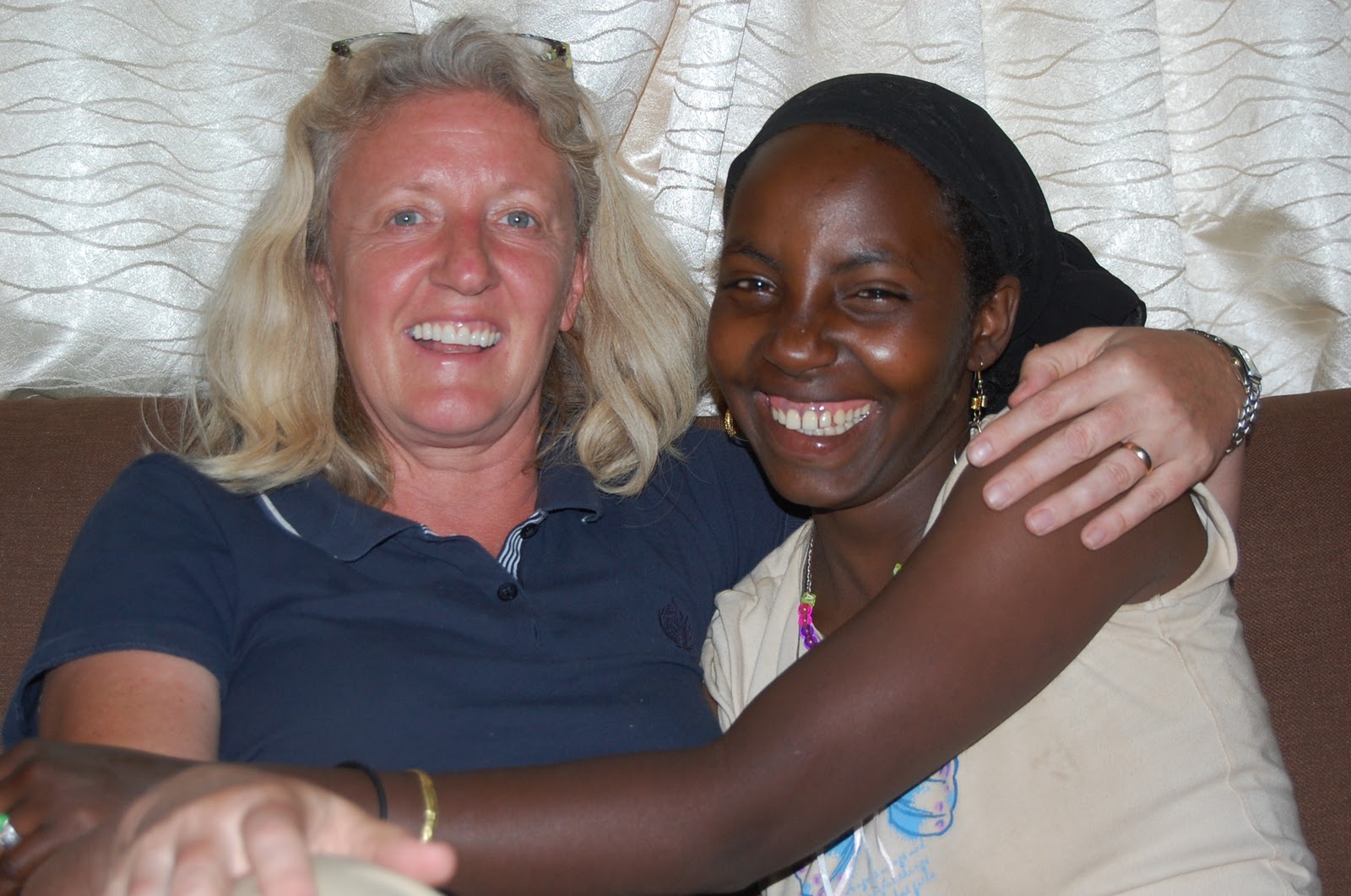
Zakir, Birka, me, Ysriba and Ashreka kneeling.  Zakir and Birka are siblings.  Zaakir only has one change of clothing.  I'm taking some clothes for him next trip.  Probably something of Zacks.  He is 19 years old and sends all of his money home to his parents.  Zakir takes care of all the animals here. 
 Birka and me.  Birka is 17 and bossy.  She is darn cute and is a pretty good maid.  She is from Beltu.  Birka speaks pretty good English and finished 10th grade.  I met her mother one day and she was the first lady I met here in Ethiopia that was heavy.  

Ashreka and me.  Ashreka's marents married her to a man when whe was just 15.  She is now 17.  She left her husband and I think she has a baby, but she won't admit it to me.  The other maids tell me that she does.  She said her husband wouldn't work and chewed chat all day, so she left him.  I don't know how that works in this Muslim area.  She is one of the hardest working girls here. She is good at butchering chickens.


This is Keay.  She comes from Ginir.  She is Wubishet's sister and has gone to university for two or three years.  She is a soccer coach, but has come to be our maid for a while.  She is much more knowledgeable about things than the other maids and speaks pretty good English.  She is a very good worker too. She is good at skinning chickens.
 This is Ysriba.  She is the sweetest of all the maids and she is the best laundry washer too.  She loves to pet me, as you can see.  She is 19 and comes from Beltu I think.  She has a lazy eye, but she would be a great catch, cause she is so sweet and knows how to take care of laundry well.  Ysriba also knows how to butcher chickens.

This is our shy little Misra.  She mainly works for Heidi and Mark, but will come and do things at my house too.  She is a sweetheart. 


It really is hard to say goodbye to all these people.  I have talked to Wes and Alyssa and they will have all the maids stay even though we won't be there for them to help.  I was glad to hear that, for I have grown attached to them.

Friday, April 23, 2010

Darn That Volcano!!!

This is Morgan by the way. I am currently skyping with my dad and he is telling me that nothing is set in stone and as of right now they are to become Ethiopian citizens and live there the rest of their lives.... Just kidding. They are just having a lot of trouble getting the Ethiopian Airlines to cooperate as well as their travel agent. As of right now things are very unsure so we will have to wait and see.
Morgan

Monday, April 19, 2010

April 18, 2010 - We are coming home!

Hello Everyone!

It's so nice to get up here to Addis where there is a somwhat reliable internet service. The last week we didn't have any communication from outside Beltu area and it was frustrating. You don't realize how much you rely on the internet until it isn't available to you anymore. Someone, in the dark, walking through our yard probably tripped over the cord pulling the internet modem off its place. When they discovered the modem on the ground, it was not working anymore. But now I'm here in Addis where I can read your emails and send some of my own.

The volcano erruption in Iceland has really made us worry about getting home. Bracken is supposed to fly tonight at 11:50, but his flight is cancelled as of now, and he doesn't even know when he'll even be leaving. I can't check anyone's blog, because I think that up here in Addis they are blocked. Darn, I love to see the blogs. Fortunately we have been able to talk to Morgan and Grandma and Grandpa Baum on the satellite phone this week, so that is good. Today the weather is mostly cloudy and I expect it to rain. Alan has been in meetings all day today with financial officers and purchasing departments. He is getting frustrated at how this operation gets bogged down, because of our miscommunications mostly. Everything is so green and beautiful here in Addis and the temperatures are very mild. Even though it is gray outside, it is still warm enough for me. However, I do see that a lot of the local people here get very cold if it is cloudy and rainy. They're not used to dealing with harsh weather conditions.

Today I went out with Tedi, a driver for the company and Nadi, a finance clerk and teacher who works with us on the farm in Beltu. Nadi traveled from Beltu to Addis with us yesterday. We went out to purchase fresh fruits and vegetables to send back to the farm with Nadi when he goes. I first went to Bambi and then to Friendship which are more American type grocery stores. After that, we went and found some souvenirs to take home with us.  As we wove in and out of traffic I felt that several times we were going to collide with another car or mow down a pedestrian. Amazingly we got to the stores and back without any mishap. I had to just sit in the back and try not to gasp or scream as we tore down the streets and darted in front of other drivers. The driver told me there is no electricity for the lights to operate. I asked him if this was common, and he said “yes, they never work.” Too funny! You honestly don’t stop at any intersection, you just go through honking.

Last night when we got here I had a hot shower! I’ve not had one in over a month. We all felt happy to go to bed clean. When I awakened in the morning I felt like I had been unconscious for 10 hours. When I get home to the states, I will blog and tell details about the last 10 days. And I should be able to get a lot of pictures too. We’re excited to see friends and family, and really good food. We were counting on going out to eat after our arrival, but then we realized we don’t fly into IF until 11:00 p.m. on Wednesday night. Just wanted to let everyone know we are well and happy. Thanks for sending emails to us. We love them!

Wednesday, April 7, 2010

The Planting has Begun!!!! April 5 - 7, 2010

Tuesday, April 6, 2010


Yesterday was really stressful for Alan, and probably he stressed several others out at the same time (Amin, Bracken and Nahom). Planting is not going the way we expected. We obviously are not using anything close to drills. The most modern way here is to use a broadcast spreader. The wheat seed, Di 'Ammonium Phosphate or DAP, and Urea all come in quintal sacks. A quintal is a measurement of 100 kilos. The seed, DAP and Urea are all transported by tractor and wagon out to the field.


A group of men open the sacks and mix them into the scoop of a loader, which then dumps the mixture into the broadcast spreader. The seed and fertilizer are mixed at a ratio of 1.5 quintal seed, 1.5 quintal urea, and 1 quintal DAP. The broadcast spreader is a large bin on wheels. For those of you who aren't farmers, it works like one of those handheld things you use to fertilize your lawn. As the tractor pulls the broadcast spreader down the field, seed, and fertilizer are spread across a swath of about 25 - 30 feet. At home, when you drill the seed into the soil, you can see exactly where you've been. Here, as the tractors move down the field, there are three men standing at each end, and in the middle with big flags to show them exactly where to head because the seeds are spread on top of the soil and they're hard to see from inside the tractors. Then tractors with disc harrows follow behind and disc the seed into the soil.


It's a pretty slow, ineffective way of planting, but its way better than the alternative, which is to hire a bunch of workers and have them sow it by hand and then cover the seed with using hoes. Crazy! So, even under these conditions they were able to plant about 200 acres yesterday. Alan wore himself ragged running back and forth between the seed stacks and the field planting. Remember, we have no vehicles here to drive back and forth from the seed stacks to the fields. You have to catch a ride on the tractor wagon or hoof it. If we can get the GPS working well, they will be able to work when it is dark and work longer hours. It hasn't rained for the past few days, and everyone is working fast to get as much planted as they can before the rainy season. So far we've been blessed. Today they started out in the field at 8:00 am and were going strong at noon. Alan and Bracken were both in a much better mood. They are having to come up with all kinds of solutions to the problems of not having the tractors and air drills here for this planting season. We've all had to take a step back in time and figure out how to do without our superduper American technology and equipment.
As I was out watching the planting begin a man came up who wanted to sell a chameleon. I didn't want to buy it but I did take some pictures. There have been several chameleons brought to the farm. So far they have all died when they get here.


Tonight a man brought a baby baboon to the farm to see if Wes would buy it. Wes likes to see the exotic animals up close and personal. The little baboon was tied into a basket and then the basket was in a sack that was all tied up. He was really scared when they got him out and became a little frantic at one point. The baboon was vetoed as a house pet for obvious reasons. He was as smelly as a pig pen and he was just a baby.

Tuesday, April 6, 2010
Today I stayed inside most of the day because I got a bad sunburn yesterday from walking out to the fields twice. Once to go see what was happening and the second time to bring my camera along to take pictures of all the exciting action. I burned my calves and arms badly - we're all of the opinion that the suns rays are much more intense and that we need to be more careful of our skin. Alan, Bracken, and Val are getting very dark, while some of us get red or stay white.te. Another reason I got sunburned was because I decided I had to tackle the laundry issues. Last week I found several of my socks ground into the dirt underneath the clothesline and one got even as far away as the restaurant. I almost couldn't recognize them as socks. Also I have underwear issues. I feel that I shall have to always wash Alan's and my socks and underwear myself instead of having the maids do it. So I stood out in the sun and handwashed our clothing until it was as clean as I could get it. The maids take offense when I do this. I think there could be two reasons for this. One: they think I don't trust them to get my clothes clean, or two: they feel their job is threatened because I don't need them to wash my clothes. Whatever, there are just some things in which I'd rather have control. I had a shower this morning using one of my trusty buckets and my pitcher. I dump water on my head, lather up, rinse, condition, rinse again and again, and then I'm done. It's really cold and so I take a big breath and go for it. I find halfway through that every muscle in my body is clenched and I have to remind myself to breathe. I don't take that many showers anymore. I've gone natural. This is the usual showering method over here. We sometimes get running water, but usually not.

Tonight I made sweet and sour goat. Anytime I say goat anymore, I crack myself up. It actually turned out pretty good and Clair and Alan really liked it. We are having to deal with goat meat over here, so you do what you can to make it different and tasty each time you serve it. We had some vinegar saved for the sour part, but this afternoon when I needed to get the vinegar, I found instead that the bottle had been emptied and used to store milk by one of the maids. She had bought the milk earlier and thought that the vinegar was not good so she tossed it. Darn it! They just don't get that you need vinegar to make good sweet and sour goat. She was going to turn that milk sour I'm sure and then drink the clabber with burburi Stirred into it I've actually seen this done. GROSS!

Tonight I found a little note that Birka had written in the back of my notebook. This is what it says:
My name is Birka Mamina. I came from Beltu town. But now I live in Westown. This house is Shelley house. It is very handsome house. I love this house and I love Shelley more than all. I like banana bread.

Another maid wrote: I like orange. My name is Misra Yequb.

I love my maids. I'm glad that they are here to keep my mind on all the funny, sweet, cute things they do everyday. They love me because I give them suckers and lotion for their hands and faces.

Wednesday, April 7, 2010
Started the day by going on a walk with Alyssa and Linda. There was a large cranelike bird in the field, so Alyssa got some pictures. I'm curious to see them up close. It looked about waist high. Came back by way of the restaurant and asked them if they had any eggs. They said maybe on Friday. I had the maids wash the remaining glazing putty off the outsides of my windows. I did all the insides of the windows and they did the outside. It was very hot and they needed suckers and water to continue. A man came along after lunch with a chicken and wanted me to buy it. I wasn't sure how much to pay for the chicken, so I asked Ashreka and she said maybe birr 30. So I said how about 20, and he said birr 25. Sold! For approximately $ 2.00. Good bartering on my part, I think. Ashreka wanted to butcher the chicken for dinner, so that's what happened. She got some guy to kill it and then she and Keay kind of skinned the bird and cut it up and washed it out really good. They did a good job and I got pictures.


Just as we were finishing with the chicken, a mother, a grandmother and two children showed up to see the doctor. One of the children was a little girl with a badly burned leg, and the other was a boy of about 10 who had swollen arms, legs, and a distended abdomen. It looked so painful and he was running a temperature of over 100. We couldn't do anything for the little boy, but made a call to Addis to report the symptoms. We cleaned, and bandaged the little girl's burns.


There are not enough doctors here in Ethiopia. We don't know of a doctor between here and Shashamene. That's not good. We're going through the first-aid kits like crazy, and they are supposed to be for the farm and those people who work here, but the need in the community is so desperate that we do our best and give them whatever we can. We finally got the little girl taken care of and gave her and her brother a sucker. Candy helps with the little ones, I think. I have to remember to bring lots of suckers over next time I come.

The farming is going well; we are continuing with the same method. The loading and transporting of the grain and fertilizer to the fields, then mixing, then dumping, then spreading, then disking. Alan is reporting to me every night, and he thinks it went OK yesterday, and I could tell at noon that everything was alright today also. I just asked Alan about how many hectares we have planted in three days and he said 400.  Pretty good considering what our methods are.  Everyone is working really hard.  We're living the dream, as Bracken says.

A serious thing to report; Sheik Alli, the head of security over the farm was seriously injured yesterday in a car accident. Apparently he, his driver, and a few others were headed to Ginir from Robe and they had some kind of accident which caused the land cruiser in which they were traveling to roll over about four times. Kind of a freak accident.e driver and Sheik Alli was transported to Addis Ababa and has a broken back. He is paralyzed from the waist down.  He is an important man in this region for he is a religious leader as well as some kind of policeman, I think. I'm not totally clear on that. He is supposed to be helping to keep the peace dwon here in this region. So we really feel bad about his accident, not only for him, but because the land cruiser was one of the vehicles we had been using on the farm. So, crazy, huh?

It's good to get your emails. Keep them coming, they cheer and help us through many tough days. Bye for now.

Sunday, April 4, 2010

April 4, 2010 Easter Sunday

April 4, 2010

Work is not progressing here on the farm like we are used to in the US. However, this is the start-up year and we have to accept that most everything that can go wrong will go wrong, and everything will take twice as long as it should normally take. Communication and differences in work habits are problems. The Americans are here to do a job the American way, and the local (Ethiopians) are constantly telling Alan or whoever, that he can’t do it, or that it won’t work the way he wants to do it. They don’t understand our American ways any better than we understand theirs. For instance, when the Ethiopian tractor drivers plowed the fields, they used small plows and Alan wanted them to carefully plow all the soil. Instead, because the drivers were getting paid by the hectare, instead of the hour, they rushed through the job and didn’t plow right next to the row they had already plowed. They plowed so that the turned soil would fall over and cover a strip of unplowed soil. I don’t know if they thought Alan would be fooled or if that is the acceptable farming method here. Either way, it is not acceptable to Alan. As he checked each day, he would kick through the soil and uncover the hard soil. He told them that the weeds were growing under the plowed soil and they said no, the weeds were dead. He would kick up the loose soil from the hard unplowed ground, revealing the growing weeds, showing them the problems. Simply put; weeds take water and nutrients to grow too, and they will cut into the yields of grain. They tell him that it doesn’t matter, the grain will grow. But anyone who knows Alan, knows that he will not be happy with the weedy fields and seeds spread over hard compacted soil. I think our American farming methods are conflicting with how it has always been done here in this country.

Last night, Saturday, Bracken arrived back from Ginir. He left Thursday and he did end up in Ginir for the holiday and on Market day. He said it was crazy! He was the leader of the whole expedition and he did very well, even bringing back mangoes, papyas, oranges, bananas, and potatoes, a cheese grater, a whole lot of drinking water, besides the three trucks loaded with fertilizer, disc harrows, and broadcast spreaders. I was very glad to know that he hadn’t been swallowed whole by a river. Bracken took three tractors with him when he left so that they could bring back disc harrows, the broadcast spreaders, and get the fertilizer trucks through the muddy roads. The fertilizer and broadcast spreaders were in Ginir and then he had to find some disc harrows and then get everything back to here safely. He met Wubishet’s ( a mechanic) mother, who wanted him to come for dinner, but he couldn’t, and he stayed overnight at Yusef’s home. Yusef’s company does most of the hiring of the workers here at the farm. Bracken was busy hiring disc harrows and getting a fuel truck and driver and he had to spend time at the bank there in Ginir. We have now switched fuel trucks and driver because our last one was a jerk. He would go for fuel to Ginir and stay, leaving the farm without fuel for a couple of days. Bracken found someone new who we hope will be honest and do the job he’s paid to do. This guy even owns his own truck. Bracken saw a troop (is that what you call it) of baboons at the river. He got some pictures he will be glad to share at a fireside when he gets home. JK about the fireside.

Today, Sunday, the workers are still not all here, because it is an official holiday here. Even though most of the people who work at the farm are Muslim, they still think they should not have to work, because it is a Christian holiday. They are unloading the fertilizer trucks so that the trucks can make it back to Ginir before more rain makes the river impassable.

When I came to the farm, I did not come through Shashamene, Robe, or Ginir because I flew down from Addis Ababa. Chances are that I will have to drive back from here, because the rain makes our airstrip here impossible to land on. In a way, I think it would be exciting and adventurous. Alan hates the drive because the roads are so terrible and the cities are ramshackled, crowded places. He’s been there and done that. I’m trying to be positive about the possibility of the drive which goes up through the Bale Mountain national park. On one hand, I want to see some more of this amazing country, and then on the other hand, I don’t want to spend a night in any of the motels on the way, because of the bad bed bug bites that can occur when occupying them. I see Val and his terrible bout with the bites, and I don’t know if I can handle the trip.

I have just had a maid come in to the house complaining of cramps. I gave her some ibuprofen and then she wanted to know if I was going to get beautiful today. Linda and Alyssa have put on some makeup and the pressure is on Ashreka to beautify me. She wanted me to look beautiful as Alyssa. No chance, those days are far behind me. I showed her my makeup bag and she went crazy. She put every lipstick on and around her mouth. She started to look like a clown she was getting it all over. She would look at herself in the mirror and giggle because it did not look the same on her as it did me. She wanted me to put on my eyebrows, and then when she used the pencil we couldn’t even see it. She started putting powder all over her face and then she laughed when she had all the white streaks on her. I put mascara on her and she kept blinking and jerking away. I put some blush on her which I couldn’t see, but she definitely saw a difference and then started putting it all over her face. When I said she was done, she hugged me and said, “I love you Shelley, I am beautiful, Shelley. Thank you Thank you thank you. What a funny girl. She is so cute. I love her too.

Last night we got to hear the first Saturday session of general conference. It was so nice to hear the organ playing and then the sounds of the Tabernacle choir coming into the house. I didn’t stay up (11:00 p.m. – 1:00 a.m. our time), for the second session. We hope to hear the first Sunday session at 7:00 p.m. tonight, our time. I’m thinking of all of you there in the US, knowing that most of you are having a delicious Easter celebration dinner with ham, potatoes, salads, deviled eggs, desserts, and lots of easter candy, etc. , and I will be here with our small group trying to be OK with another goat dish. Actually we will be having mashed potatoes, gravy, corn, a cabbage slaw salad, papya, and yes, leg of goat! We are excited and I think Alyssa has come up with some kind of coconut pie to serve for dessert. I saw her crushing cookies last night for the crust, I believe. Either she is making the pie for all of us, or she and Wes had a lot of cookie crumbs in their bed last night. I will just say that Alyssa truly amazes me. She is dealing with this whole thing in a remarkable way, as is her mother, Linda. They are very creative and inventive when it comes to food. They make every meal a good meal, using such ordinary items. I need some of that to rub off on me.

On this Easter Sunday our thoughts and prayers are with all of you, our friends and family, at home in Idaho, Utah, Arizona, California, and Illinois. We love you dearly and miss you so much. We want mom in Arizona to know how much we love her and wish we were there to see her and talk to her in person. Skyping is good, but not as good as being there. We are proud of our dear missionary Zack and hope at this Easter time he may feel the blessings of the atonement in his life. We pray that Jack and Les are doing well in their missionary endeavors as well. Be thankful for the bounties and blessings that you enjoy each day and recognize that God is aware of you and he will comfort you and give you peace in your hearts at this blessed Easter time.

Thursday, April 1, 2010

Water Problems and Goat Butchering April 1, 2010

April 1, 2010

We have had a difficult time here on the farm this last week. Most of our problems are due to H2O, or water. Either too much or too little. It was dry last week, and then this week we have had too much rain. When it rains, it pours here, and it rains always at the same time which is early morning. By 10:00 am, the sun is usually out and the puddles disappear. However, this soil really soaks up the water and makes a slimy greasy mess. After we walk around in it for about five minutes, we’re all about two inches taller, and we all look like we’re wearing clown shoes. It doesn’t seem to bother those people who live here or the Americans who have been here for awhile, but I’m constantly trying to get the muck off my shoes, and I know the people are probably laughing at me thinking, “silly white woman, why is she bothering?” And I ask myself that too, “What’s the big deal about clean shoes, I’m the only one that’s worried about it.” The rain also stops the farming from progressing. Those of you from Ashton and our other farming followers know that you can’t get too much done when you have just measured about 2 inches of moisture in the last 24 hours. The winds start first at about 3:00 or 4:00 in the morning and then we know the rain is soon to follow. The rain lasts until around 7:00 am. Our houses are not the kind that are really weather proof. I have cracks in the corners that I can see daylight through, and the windows let in ginormous amounts of rain, so when we wake up in the morning we sometimes are standing in good amount of water. This morning, there was a huge puddle in my living room. I was once again irritated when I saw it and I waited for the maids to come and clean it up. When I told Birka that she needed to mop up the puddle, she laughed and ran over to it and used it to wade in and wash her feet. I got a kick out of watching her; Birka is teaching me how to make lemonade out of lemons.

Another problem with all the rain, is that it literally shuts down our way of getting out of here. The roads are like pools of water in some places, and they’re very difficult to maneuver. In some places where there were small streams of water, they are now rivers and we haven’t been able to navigate our way through them. For the last few days we have not been able to get our normal amounts of water for running the farm because of all the rain. All these many people here depend on the water truck with its large tank to bring water for cooking, washing, making cement, laundering, etc. When the truck can’t make it through the muddy and flooded conditions, we’r e all concerned. Mark brought a couple of small tank loads of water in yesterday and that got us by, but we really needed more. They went out looking for water this afternoon with the water truck, a loader and I think a tractor to pull them through the worst parts. What a production.

Another problem that we have been having is getting anything ordered from Addis. One truck of fertilizer is here, and another is stuck in Ginir. Bracken, along with about eight workers went to Ginir to get the fertilizer and a PTO. Bracken sent Hailii in a tractor and I think two other tractors with drivers and two more in each tractor also went. Bracken took the Land Cruiser and will stay the night there and he hoped to return on Friday. He was also supposed to stop at a town along the way and ask the government authorities there if it would be OK if the farm could use some area close by where we could store containers coming and going from Addis. There is a river between here and Ginir that is bad (no bridge)and those truckdrivers don’t want to cross the river with their containers. I don’t blame them. It could be treacherous. I think that maybe we will have to go get the containers and bring them across the river and then to the farm. I think that’s the plan. I thought it would be fun to go to Ginir, but Alan and Bracken both said it wasn’t a great place. I asked if it was as bad as Hanksville in Utah, you know out in the middle of nowhere with very little in the way of amenities. Alan said it was like Hanksville only with 2000,000 people. Ginir is one of the places where Val got bit by bed bugs. I hope Bracken doesn’t get bit. Needless to say, Bracken was not thrilled with his assignment today.

Tomorrow is good Friday which is a holiday here in Ethiopia. Saturday is the day the Muslim population have off for their weekend day, and then Easter Sunday is also another holiday. Many of the workers planned to get off the farm and go somewhere for the weekend, so it will be a quiet weekend for the Americans. Bracken hopes to make it home so he doesn’t get caught in Ginir during the holiday time.
Now, I must tell you my goat story. On Tuesday, I wanted to have some goat meat and after some investigation I was told that we could buy a goat from the restaurant, you know the tarp and stick place. Wes, went and bought the goat, and arranged to have it slaughtered also. He then gave them a garbage container to put the goat in after the demise of the goat. We got the goat delivered in large pieces, four legs, a back bone, two rib pieces, the pelvis area and one or two other pieces I couldn’t identify. No one was too excited about butchering the goat, so I cut up a little bit for dinner that night and put the rest in plastic bags in the freezer. I worried about it all night for fear it might have ecoli. The next afternoon, I went to work and cut up the unidentifiable pieces and the two back legs. I wanted to keep the legs in large pieces for our Easter Sunday dinner. However, I still don’t think they’ll be tender. I kept thinking to myself, “Im cutting up this stupid goat on Alyssa’s kitchen table, and I’m actually getting pretty good at it.” I had to keep saying to myself, “goats are related to lambs, and lambs are good to butcher and eat.” It was the only way I could keep on going. I can’t say that I like goat meat, I find it tough and not very tasty, but just ask me if I can butcher a goat and I can say “Yes, like any good Ethiopian, maybe not as good as an Ethiopian, but I can do it!”